Introduction
Encryption has long been treated as the cornerstone of privacy-preserving systems. Modern web applications routinely encrypt data at rest and in transit, relying on cryptographic guarantees to protect sensitive information from unauthorized access. While encryption is essential, it is not sufficient to address many real-world privacy risks arising from persistence, reuse, and residual data exposure.
This article argues that ephemerality — enforced, deterministic lifecycle termination of execution environments and state — is a stronger and more practical privacy primitive than encryption alone for a broad class of web-based systems. Rather than attempting to protect data indefinitely, ephemeral systems reduce the amount of data that exists in the first place, thereby shrinking the attack surface and limiting post-session exposure.
The discussion is grounded in real production architectures, including ephemeral browser sessions, private file sharing, and private note systems, where privacy guarantees are enforced through lifecycle design rather than policy-based cleanup.
The Limits of Encryption-Centric Privacy Models
Encryption answers a narrow question:
Who can read the data if it is accessed?
It does not answer:
- How long the data exists
- Where residual copies may remain
- Whether metadata persists
- How reliably deletion is enforced
Persistence Is the Hidden Risk
In traditional encrypted systems:
- Encrypted data is stored indefinitely
- Decryption keys often persist in memory
- Backups, logs, and caches retain copies
- Cleanup is selective and error-prone
Even perfectly encrypted data becomes a liability once:
- Keys are compromised
- State is reused across sessions
- Artifacts are unintentionally retained
Encryption protects confidentiality, not lifecycle control.
Ephemerality as a First-Class Privacy Primitive
Ephemerality shifts the core design question from:
“How do we protect stored data?”
to
“Why should this data exist at all beyond its immediate purpose?”
Definition of Ephemerality
An ephemeral system enforces:
- Short-lived execution environments
- No shared persistent state
- Deterministic teardown
- Irreversible destruction of artifacts
Crucially, cleanup is not selective.
The system does not attempt to identify which files, caches, or memory pages are safe to delete – it destroys the entire environment.
Architectural Comparison
Encryption-Centric Architecture
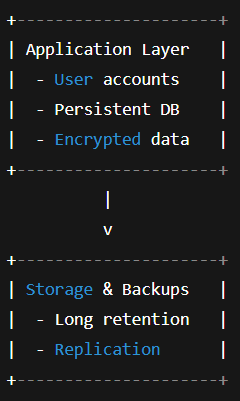
Privacy relies on:
- Correct key management
- Correct cleanup logic
- No future compromise
Failures compound over time.
Ephemeral Architecture
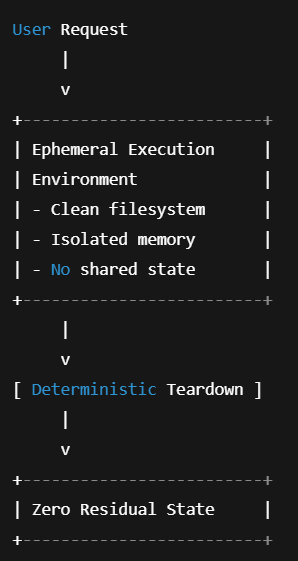
Privacy relies on:
- Lifecycle enforcement
- Isolation boundaries
- Guaranteed destruction
There is no long-term data to protect.
Deterministic Teardown vs Best-Effort Cleanup
Traditional systems rely on best-effort cleanup:
- Clear cookies
- Delete files
- Wipe cache directories
- Rotate keys
These approaches fail silently.
Ephemeral systems rely on:
- Immutable session boundaries
- Full environment destruction
- Infrastructure-level guarantees
This is a qualitative shift, not an incremental improvement.
Case Studies: Applied Ephemerality
Ephemeral Browser Sessions
In conventional browsers:
- Cookies persist
- Local storage accumulates
- Session state leaks across time
In an ephemeral browser model:
- Each session runs in a disposable execution environment
- No browser profile is reused
- All artifacts are destroyed on termination
This limits:
- Cross-session tracking
- Credential reuse
- Residual data leakage
Ephemeral Private File Sharing
Most “secure file sharing” tools:
- Encrypt files
- Store them on persistent infrastructure
- Rely on access policies
An ephemeral model:
- Binds file access to a short-lived execution context
- Eliminates long-term storage guarantees
- Ensures files cannot be accessed after teardown
The privacy gain comes from absence, not encryption strength.
Ephemeral Private Notes
Similarly, private note systems traditionally:
- Store encrypted notes in databases
- Depend on deletion policies
An ephemeral approach:
- Creates notes inside disposable environments
- Never persists identity-bound state
- Guarantees irreversible destruction
The result is provable non-retention, not “trust us” deletion.
Threat Model Implications
Ephemerality directly mitigates:
- Cross-session state persistence
- Post-compromise data exposure
- Credential reuse
- Residual forensic recovery
It does not claim to prevent:
- Active session attacks
- User-initiated disclosure
- Network-level correlation
This clarity avoids overstated security claims — a critical distinction for serious system design.
Why This Matters Practically
Ephemerality:
- Reduces compliance burden
- Shrinks breach impact radius
- Simplifies reasoning about privacy guarantees
- Aligns system behavior with user expectations
Instead of promising protection forever, ephemeral systems promise not to remember at all.
Positioning
This work does not claim invention of encryption or browsing.
The contribution lies in:
- Treating ephemerality as a primary privacy primitive
- Applying deterministic lifecycle enforcement across multiple system domains
- Demonstrating practical, production-ready architectures
Conclusion
Encryption is necessary, but it is not sufficient.
By designing systems that intentionally forget, ephemerality provides stronger, more reliable privacy guarantees than encryption alone. In an era of increasing data retention and long-lived execution contexts, ephemeral architectures represent a pragmatic and scalable shift toward privacy by design.